
Solo or ten players
The description allows solo or up to ten friends, and servers hold fifty. Two badges require another person: Not On My Watch for pulling a friend off the squatter, and Armed Escort for handing EXG a shotgun.
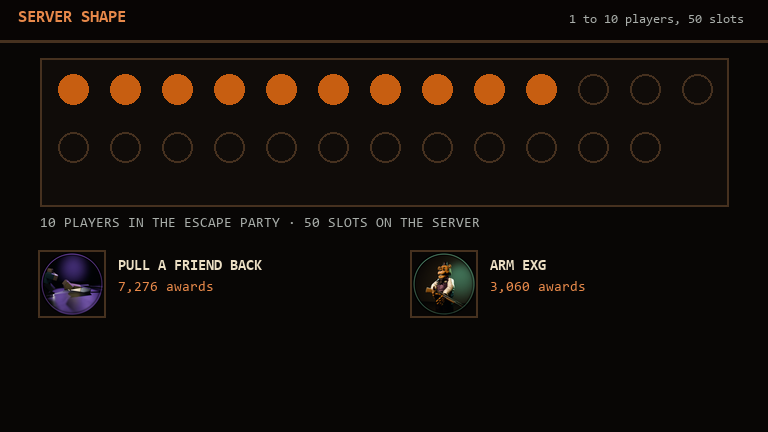
Closing Shift's first bullet is "Solo or with up to 10 friends." The game's server cap is 50. Those two numbers describe different things, and misunderstanding the difference is how groups end up spread across a restaurant with no idea who is in their run.
The two numbers
| Number | Meaning | Source |
|---|---|---|
| 10 | Maximum players in an escape party | Official description |
| 50 | Maximum players on a server | maxPlayers field |
| 1 | Minimum players | Official description ("solo") |
A full 50-player server is up to five separate runs sharing one building. Nothing in the official description says parties are instanced; what it says is that the group cap is ten.
The practical consequence is a rule that sounds odd and is not: agree on your party before you go down. If four groups of ten are in the same restaurant, the key you find may be the key three other groups are also looking for.
Does co-op actually help?
The badge data answers this better than any opinion. Two badges cannot be earned alone:
| Badge | Awards | Condition | Players needed |
|---|---|---|---|
| Not On My Watch | 7,276 | Save a friend the squatter is dragging away | 2 |
| Armed Escort | 3,060 | Hand EXG a shotgun | 1 (EXG is an NPC) |
Not On My Watch is the real evidence. Its condition requires a second player to be in trouble and a first player to intervene, which means the squatter grabs players and other players can pull them out. That is a rescue mechanic, and it exists only in multiplayer.
7,276 awards for saving a friend. Against 132,604 for flashing the squatter away on cameras — a solo action — the rescue is eighteen times rarer. Either it is harder, or most players are not in a position to attempt it.
What solo costs you
Four things are harder alone, and three of them are structural rather than about difficulty:
Nobody watches your back at a hatch. Player reports describe a one-at-a-time service hatch. Solo, that is fine. In a group, the queue at the bottom is the danger.
Nobody holds the light while you read. The exit panel needs to be read. Foxy needs a light on his face. Doing both at once is possible and worse.
No rescue. The squatter can take you, and no one is there to pull you back. Not On My Watch is unobtainable solo by definition.
No split for the fourth key. Four keys, one player, more walking. Every extra corridor is another chance to be seen.
What solo saves you
No coordination tax. Every group spends time agreeing on a route. A solo player just goes.
No shared risk. The description's party mechanic implies a birthday song that affects the room, not the player. A group that splits during the song loses members; a solo player either stayed or did not.
No key contention. In a 50-player server with multiple parties, keys are a shared resource. Solo play has the building to yourself, at least in terms of who is competing.
The badge counts support solo being viable: 80,777 escapes, and only 7,276 cooperative rescues. The overwhelming majority of successful runs happened without a rescue.
The co-op configuration that works
If you are bringing people, the roles that map to the game's actual mechanics:
| Role | Job | Why |
|---|---|---|
| Reader | Gets to the exit panel early and reports the digits | Only the panel has the correct code |
| Light | Holds the torch on Foxy when he appears | The one stated counter in the description |
| Runner | Takes keys and does not stop moving | Four keys, one player, minimum walking |
| Watcher | Cameras and callouts | Camera Shy is the fourth most-awarded badge for a reason |
Four roles, four keys. That is not an accident of design — it is the shape a four-player party falls into naturally if everyone picks one job instead of all doing everything.
What ten players looks like
Ten is the cap, not the recommendation. Beyond four, the extra players mostly add noise: more people to rescue, more bodies for the squatter to grab, more footsteps to confuse your audio, and more people who need to be told what the code was.
The useful upper limit is the number of simultaneous tasks: one reads the panel, one holds a light, and everyone else collects. Four to six is where that stays legible. Above that, a group is a crowd.
The one mechanic that only works in a group
Not On My Watch — 7,276 awards — is the badge that justifies the multiplayer design. Somebody gets grabbed, somebody else pulls them back. That is a moment no solo player will ever have, and it is the strongest argument for bringing one friend rather than nine.
If you only ever play solo, you are not missing the game. You are missing one badge, one rescue mechanic, and one person to tell you the code was on the panel.